Two intrepid librarians

Two intrepid librarians review the best nonfiction books for children

Showing posts with label Civil Rights. Show all posts

Monday, December 4, 2023

Coretta's Journey

Coretta's Journey: The Life and Times of Coretta Scott King
by Alice Faye Duncan
illustrated by R. Gregory Christie
Calkins Creek, 2023
Grades 3 and up

Coretta's Journey eloquently blends poetry and prose to tell the life story of civil rights activist, Coretta Scott King. This powerful picture book biography is organized chronologically and includes dates to help readers place the events in history. Duncan incorporates quotes into the narrative and poems as she describes the life and accomplishments of the fearless and steady civil rights leader, mother and wife.

Christie's mixed media watercolor illustrations evoke a range of emotions from joy and wonder to determination and grief. Rich back matter includes photographs, a timeline and author's note. Coretta's Journey is a recommended purchase for upper elementary and middle grade readers. Look for the title to appear on awards lists in the coming months!


Monday, May 29, 2023

Holding Her Own: the Exceptional Life of Jackie Ormes. Words by Traci N. Todd; Pictures by Shannon Wright


Holding Her Own: the Exceptional Life of Jackie Ormes 

Words by Traci N. Todd; Pictures by Shannon Wright

Orchard Books. An Imprint of Scholastic Inc. 2023


“This story begins — as many stories do — with a blank page, an empty space waiting to be filled…”


And, so begins this captivating picture book biography on the life of Jackie Ormes, the first Black cartoonist to be syndicated in the United States.


The illustrations, created digitally, resemble a collage that are placed alongside the colorful double-page spreads of the comic characters created by Ormes. 


Jackie Ormes (named Zelda) was born in 1911 outside Pittsburgh, Pennsylvania. In 1945, Ormes created the comic, Patty-jo’ n’ Ginger. It was Ormes platform to comment on Black life, the war and its aftermath, and the fight for social justice. Patty-Jo’ n’ Ginger would run until 1956.


Included is an author’s note, a note from the artist, and a selected bibliography.


This powerful biography, for all ages, especially high schoolers, is a reminder that readers can use their voices to speak out about injustices and use their talents to bring about positive change. 


Click here to see a short video by Todd and Wright promoting this book. 

Monday, May 8, 2023

To Boldly Go: How Nichelle Nichols and Star Trek Helped Advance Civil Rights Written by Angela Dalton: Illustrations by Lauren Semmer

To Boldly Go: How Nichelle Nichols and Star Trek Helped Advance Civil Rights

Written by Angela Dalton: Illustrations by Lauren Semmer

Harper. An Imprint of HarperCollins Publishers. 2023


Many people, myself included, loved Star Trek for showing the possibility that their could be peace and acceptance throughout the universe if we only would embrace one another as equals.  For Angela Dalton, TV night - the best night- meant a glass of sweet, syrupy red Kool-Aid and the show, Star Trek. Watching the crew of the starship Enterprise “boldly go where no man has gone before”, exploring strange new worlds was very entertaining, however, for Davis, seeing Lieutenant Uhura “brought them pride that someone who looked like us standing as an equal to make the future better for everyone.”


To Boldly Go is an empowering tribute to Nichelle Nichols, who played Star Trek’s communication officer, Lieutenant Uhura. Though her character showed her unlimited opportunities, in real life Nichols was faced with racist attitude that, for some reason, white people think they are better than Black people. As popular as she was playing Lieutenant Uhura, Dalton highlights the many instances where Nichols lost her self confidence. “It seemed neither she nor her character would ever be seen as important or equal.”


It was after a chance meeting with Dr. Martin Luther King Jr. that changed her plans of quitting Star Trek. Dr. King said, “you have opened a door that must not be allowed to close. Don’t you see that you’re not just a role model for Black Children? You’re important for people who don’t look like us. For the first time, the world sees us as we should be seen, as equals, as intelligent people.”


Dalton explains in the summary, Beyond Star Trek, Nichols was asked by NASA to help them make a positive connection with women and minority astronaut candidates. Nichols said she would, but threatened to file a class-action law suit if, in a years time, “I still see a [white], all-male astronaut corps.”


This powerful picture book biography traces thelife of Nichelle Nichols, as well as, emphasizing how influential her character, Lieutenant Uhura was in encouraging equality and the interest in space exploration. Highlighting the narrative is the bold art of Lauren Semmer. The marriage of words and art really bring this story to life.


Included throughout are direct quotes from Nichelle Nichols. She


Nichelle came up with the name “Uhura” which is a Swahili word for “Freedom”. To Nichols, it meant strong, independent, equal.   

Friday, April 14, 2023

From 2021: The Black Panther Party: A Graphic Novel History by David F. Walker; Marcus Kwame Anderson


The Black Panther Party : A Graphic Novel History
by David F. Walker;
Art, Colors, and Letters by Marcus Kwame Anderson

Ten Speed Press. 2021


The Black Panther Party for Self-Defense was founded in 1966 by Huey P. Newton and Bobby Seale in response to the decades long violence against Black Americans. The Black Panther Party for Self-Defense was a radical political organization that was “in defiant contrast to the mainstream civil rights movement”


Using the graphic novel format, Walker does an excellent job of explaining circumstances that led to the formation of The Black Panther Party for Self-Defense, their commitment to supporting the Black communities with their educational and healthcare programs, and their battle to stop police brutality. 


As a response to the 1967 riots in Detroit, President Lyndon B. Johnson appointed an 11-member commission to investigate the causes of the riots. The commission was led by Illinois Governor Otto Kerner, Jr. The commission was tasked with answering these three questions: “What happened? Why did it happen? What can be done to prevent it from happening again? 


On February 29, 1968, the Kerner Report was published. The report was a scathing condemnation of White America. “What White Americans have never fully understood but what the Negro can never forget—is that white society is deeply implicated in the ghetto. White institutions created it, White institutions maintain it, and White society condones it.” Instead of taking the recommendations from the 426 page Kerner Report that could have put an end to the racial disparity against Black Americans, the report was ignored. Instead, J. Edgar Hoover and the FBI waged a secret war against The Black Panther Party for Self-Defense. Sadly, many leaders were brutally and unfairly murdered at the hands of police. 


In his afterword, Walker states, “It is worth noting that, more than 50 years after Huey P. Newton and Bobby Seale founded the Black Panther Party and draft the Ten-Point Program as their guiding manifesto, every single concern they address is still relevant. Every single inequality, injustice, and form of oppression impacting the Black community in 1966 is still going strong, well into the 21st century. What the Panthers wanted in 1966, we still want now. What they believed, we still know to be true.”


Growing up, the conversations regarding The Black Panthers leaned more towards their violence than highlighting the good things they did, such as establishing important social programs - free breakfast and schools - and their fight to end social inequality. In Walker’s graphic novel history, the marriage of facts mixed with invented dialogue, and Anderson’s art make this a powerful, well-balanced book for high school students on a little known topic.


Interspersed throughout the narrative are 16 bios of Black Panther members, a bibliography, and index.


Without the knowledge of what came before, there is no hope of making our world a better place for all people. 

Monday, January 9, 2023

Love is Loud: How Diane Nash led the Civil Rights Movement. Written by Sandra Neil Wallace

Love Is Loud: How Diane Nash Led the Civil Rights Movement          

Written by Sandra Neil Wallace;
Illustrated by Caldecott Honor Recipient Bryan Collier.
A Paula Wiseman Book. Simon & Schuster Books for Young Readers. 2023

“Hating people is not the solution to human problems.” Diane Nash

Sandra Neil Wallace has penned an inspiring tribute to Civil Rights activist, Diane Nash. Born in 1932 in Chicago’s South Side, Nash’s life was filled with so much love.  Her parents want her to grow up in the North rather than the segregated South. 

In high school, Nash reads books that show segregation, but since her high school includes everyone - A rainbow of colors - segregation does not touch her.

Nash’s awakening comes when she attends Fisk University in Nashville. “Your Nashville friends take you to the fair, where the air is filled with sticky, sugar smells of cotton candy. And suddenly you see it up close, between roller coasters roiling and corn-dog fryers bubble-boiling— Two signs for bathrooms: WHITE and COLORED.”

Diane Nash was one of the most influential and effective leaders of the Civil Rights Movement. Her name is not well-known. According to Wallace in her Author’s Note, “Black women activists faced both racial and gender discrimination. This gender bias also found its way into the movement.” Diane Nash led major campaigns: Nashville’s lunch counter sit-ins, integrating interstate bus travel with the Freedom Riders, and securing voting rights for Black Americans in the South with the passing of the Voting Rights Act. 

Four-time Caldecott Honor winner, Bryan Collier, illustrates this powerful picture book biography. Rendered in watercolor and collage, Collier’s art is powerful. 

Well-researched, this picture book biography includes an author’s note, illustrator’s note, timeline, bibliography, quote sources, and a selected bibliography. 
The message of standing up for what you believe with LOVE and RESPECT makes this the perfect book to share with students of all ages, especially those in middle and high school. 

Friday, August 26, 2022

Choosing Brave


Choosing Brave: How Mamie Till-Mobley and Emmett Till Sparked the Civil Rights Movement
by Angela Joy
illustrated by Janelle Washington
Roaring Brook Press, 2022
Grades 3 and up

This powerful picture book biography highlights the life of Mamie Till-Mobley and her role in the civil rights movement after the death of her son, Emmett. Don't be fooled by the length or picture book format of this book. The book does not shy away from the horrific murder of Emmett Till and the racism of the Jim Crow era.

On the first page, Emmett's body has been discovered in a river Mississippi, and Mamie requests he be sent home. As the narrative shifts back to Mamie's childhood, education and marriage to Louis Till, readers learn about the source of Mamie's strength and love for her son. Joy's writing is lyrical and poetic as she paints a vivid portrait of a strong mother who "did the braver thing" and opened her son's casket for the world to see what happened to her son. 

Washington's cut paper illustrations and use of negative space are captivating. The black, tan and light blue backgrounds contrasted against the intricate cut paper images set a serious and historic tone. After attending the murder trial where the accused were found not guilty of Emmett's murder, Mamie became active with the NAACP and traveled the country sharing her story.

Extensive back matter includes an author's note, illustrator's note, sources, list of songs from the soundtrack, glossary, and timeline. Sample artwork from the book can be viewed on Janelle Washington's site.

Younger readers (ages 8-10) would benefit from reading this book with an adult, which may lead to powerful and important conversations. Highly recommended for public libraries, school libraries and middle school social studies classrooms.


Monday, April 4, 2022

Call Me Miss Hamilton by Carole Boston Weatherford


Call Me Miss Hamilton: One Woman’s Case of Equality and Respect
by Carole Weatherford Boston; Illustrations by Jeffery Boston Weatherford
Millbrook Press, an imprint of Lerner Group, Inc. 2022.


In her latest picture book biography, award-winning author, Carole Boston Weatherford writes of Miss Mary Hamilton, a civil rights activist during the 1960’s. Her sparse text is compelling and together, with Jeffery Boston Weatherford’s scratchboard illustrations, makes this a powerful book.

Everyone deserves respect. To be addressed as Miss, Mrs, or Mr. 


Mary Hamilton was taught respect by her parents, by the nuns in her catholic school, and college. Yet, even in states that outlawed segregation, where African Americans were barred from many places, whites addressed African Americans “out of their names.” Grown men were called “boy;” grown women called “girl” or “auntie.” 


Mary believed that by addressing someone by proper titles showed courtesy and respect.  


In 1960’s Mary joined the Freedom Riders. She was jailed many times. In Alabama, she was held in contempt of court for five days for refusing to answer when a white prosecutor called her Mary instead of Miss Hamilton. In 1964, Mary took her case to the United States Supreme Court and won. “The highest court in the land ruled in Mary’s favor, deciding everyone in court deserved respect.”


Call Me Miss Hamilton includes an author’s note, timeline, and suggestions for further reading.


Click here to read an interview with Carole Boston Weatherford and Jeffery Boston Weatherford. 


A must have for all libraries, school and public. 


Another contender for ALSC/ALA awards. 


Monday, March 14, 2022

Evicted! : The Struggle for the Right to Vote by Alice Fay Duncan

Evicted!: The Struggle for the Right to Vote
Alice Fay Duncan; Art. by Charly Palmer
Calkins Creek. An Imprint of Astra Books for Young Readers. 2022


In 1965, the Voting Rights Act was signed into law by President Lyndon B. Johnson to eliminate discrimination in America’s political elections. “The law was passed to stop such criminal acts as racial gerrymandering, poll taxes, and economic reprisals.”  In Evicted!, Duncan tells the gripping true story known as the Fayette County Tent City Movement. She follows ten individuals to retell the events leading up to the trial of sharecropper Burton Dodson in 1959, and how that pivotal moment brought the Black community in Fayette County to stand together to demand their right to vote. 


“In 1950, Fayette County’s population of 28.000 was two-thirds Black, and the Black majority was made up mostly of unlearned sharecroppers living on cotton farms owned by white landowners.” To discourage Blacks from registering to vote, the white minority used fear of lynching and terror of fire. Each two-page spread, Duncan recounts the events that had families burned out of their homes and forced to relocate to a makeshift community of tents, called, “Tent City.” “Seven hundred Black families in both Fayette and Haywood Counties were removed from their farms where they had lived and worked for two or three decades.” 

Once Blacks registered to vote, their names were placed on a list, a “blacklist”, that was shared throughout the white community in Fayette County. They were denied groceries and gasoline, white doctors denied medicine, and insurance agents cancelled policies.


This well-documented narrative nonfiction includes an epilogue, timeline, list of resources, bibliography, and brief author and artist note. Charly Palmer’s illustrations, rendered in acrylic paint, capture the emotion of this time. 


An upsetting read given the present political situation, Evicted! is an important addition to all collections, a must read for middle and high school readers. 


Click here to listen to an interview with Alice Fay Duncan.


Wednesday, February 23, 2022

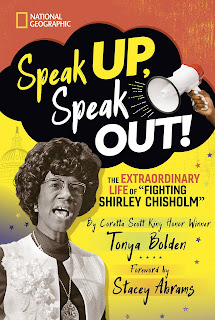
Our review of Speak Up, Speak Out! by Tonya Bolden


Speak Up, Speak Out!: The Extraordinary Life of "Fighting Shirley Chisolm"            by Tonya Bolden                                                                                                     Forward by Stacey Abrams                                                                                              National Geographic, 2022                  

With her remarkable ability to grab readers attention at the first sentence, award-winning author, Tonya Bolden has penned another must-read biography. The subject of her latest is “Fighting Shirley Chisholm”, “the first Black woman from a major political party to run for president of the United States” in 1972. Shirley Chisholm “was the candidate of and for “the people of America,” the workaday folk who make up most of the nation.” Chisholm wanted to bring a new era into American politics. Her idea was to have an America free of poverty. Politicians to this day are struggling to find a way to make this a reality.


In nineteen chapters, Bolden traces Chisholm’s childhood and her involvement in local politics until she would become America’s first Black woman in Congress. Born Shirley “Shirls” Anita St. Hill to immigrant parents on November 30, 1924, in Brooklyn, NY, Shirls was well aware of the limited job opportunities to Black people. 

Her top campaign pledges when running for congress in 1968 was: 

Job creation.

Job training programs.

Better Housing.

More day care centers.


Throughout her life, Shirls, a force, was an outspoken pioneer who shattered racial and gender barriers, who worked tirelessly for underserved communities who were ignored when it came to jobs, education, housing, and care for their children. Sworn in to office January 1969, Shirs would remain in Congress until February 1983. After which, she would teach at Mount Holyoke College, but retired from public life in 1993, siting ill health. Following several strokes, Shirley Chisholm died on January 1, 2005. 


What moved me in reading Speak Up, Speak Out! was what Bolden writes in the Foreword. She states, “How we imagine ourselves in the world often depends on what we know of our past.” For me, a white woman, I believe it is my responsibility to read widely, to learn all aspects of history, especially about those who seek to divide our nation, how acts of violence are committed against others for purely selfish reasons. Power and money makes people think they have the right to take from others without so much as an apology or a reckoning. By being informed, I hope my actions work to acknowledge, apologize and then vote accordingly to ensure everyone has equal rights. 


This well-researched, well-documented biography, Speak Up, Speak Out! is a must have for all libraries, school and public, and a must-read for all.


In this interview, Shirley Chisholm share about her experience as a Black woman in Congress, click here. 


Posted by Louise

Tuesday, February 22, 2022

Speak Up, Speak Out! by Tonya Bolden Blog Tour


Welcome to the Speak Up, Speak Out! by Tonya Bolden Blog Tour!

To celebrate Black History Month and the release of Speak Up, Speak Out!: The Extraordinary Life of Fighting Shirley Chisholm by Tonya Bolden (January 4th), 5 blogs across the web are featuring posts from the book and author, as well as 5 chances to win!


Author's Note

by Tonya Bolden

Writing a biography of Shirley Chisholm was a natural fit for me, a native New Yorker who lived for a time as a tot on Clifton Place in Bed-Stuy, who spent her wonder years in Harlem and did the rest of her growing up in the Bronx.


I was a kid when Shirley ran for the New York State Assembly in 1964 and when she ran for Congress in 1968. I was a teenager when she ran for president in 1972.


What I most remember about her during those days was her clear, clipped, bold voice. I was short on details, but I knew that she was a phenomenon, a force. When she ran for president, I remember being boggled, astonished—thinking, Wow!, and feeling so proud! For a Black girl to see a Black woman embark on such an endeavor—go where no Black woman had ever gone before—how could I not feel a surge of pride?

Making her historic announcement at Concord Baptist Church on January 25, 1972: "I stand before you today as a candidate for the Democratic nomination for the presidency of the United States of America."


When Shirley left Congress in 1982, though I still didn’t know all that much about her, I definitely understood that she was among the Black women who paved the way for me: for me to not hold back from any endeavor, any passion because I was Black and female.

In a way, with Speak Up, Speak Out! I’m saying, “Thank you, Shirley Chisholm!”

*****

While researching Shirley’s extraordinary life, I discovered other Black female political trailblazers from my hometown—women who, in a way, paved the way for Shirley.


For example, there was Bed-Stuy activist Ada Jackson, known as the “Fighting Lady of Brooklyn.” In 1944, when Shirley was in college, Jackson ran (unsuccessfully) to represent the 17th AD in the New York State Assembly. She was the American Labor Party candidate, as she was when she ran again (and lost again) in 1946.

There was also the Republican Maude Richardson, co-founder of the CBCC of which Shirley was a member. Like Jackson, twice in the 1940s Richardson ran unsuccessfully to represent the 17th AD in Albany. In 1950 she became the 17th AD’s first Black co-leader.

Another example: In 1954, when Shirley was at the start of her career with Mac Holder’s Bedford-Stuyvesant Political League, former singer and dancer Bessie Buchanan, Democrat, became the first Black woman elected to the New York State Assembly, representing a district in Harlem.

By the way, when Shirley was elected to the New York State Assembly in 1964, another Black woman, civil rights attorney Constance Baker Motley, made history as the first Black woman elected to the New York State Senate. But she wasn’t there for long. This daughter of Caribbean immigrants resigned in early 1965 after the New York City Council tapped her to fill a vacancy for Manhattan Borough president, a first for a woman. And in 1966 Motley made history again—the first Black woman federal judge.


Before I began work on Speak Up, Speak Out!, I knew that Shirley wasn’t the first Black person or the first woman to run for president— seeking to make that someday come. I knew, for example, of the radical white woman Victoria Woodhull, who in 1872—nearly 50 years before women had the vote nationwide—ran for president as the candidate of the Equal Rights Party (which nominated Frederick Douglass for VP, but he never accepted). I also knew about Dick Gregory, Black activist-comedian, who in 1968 was a write-in presidential candidate for the Freedom and Peace Party.


But I didn’t know about George Edwin Taylor. In 1904 this Black newspaperman and community organizer then of Ottumwa, Iowa, ran for president as the candidate of the National Negro Liberty Party (also known as the National Liberty Party).


Nor had I heard of the white woman Margaret Chase Smith, the first woman to serve in both the House of Representatives (1940-49) and the U.S. Senate (1949-1973). In 1964 Smith sought to be the Republican Party’s presidential candidate.


Exploring Shirley’s life opened me up to so much history!


But there were frustrations along the way. COVID-19 lockdowns prevented me from accessing certain material, such as all of Shirley’s papers at Brooklyn College. But I did my best to make the most of what I could access, from her memoirs and other books to digitized newspapers and immigration records to other documents. These included censuses and her beloved dad’s World War II draft registration card where I learned details like the name of the bag company for which he worked, and where he claimed that he was born not in British Guiana, but in Barbados.


Barbados: Where his dear Shirls once fed chickens and other animals, hauled water from a well, enjoyed so many hot, sunny days, stunning white-sand beaches, clear-clear turquoise water, and palm trees sent swaying by a breeze.


Barbados: Where her grandmother told her time and again, “Child, you’ve got to face things with courage.”


That is something a grown-up Shirls most certainly did.


—Tonya Bolden, New York City, 2020


Tonya Bolden has authored, edited and co-authored more than 40 books. Her work has garnered numerous awards, including the Coretta Scott King Honor, the James Madison Book Award, the NCSS Carter G. Woodson Honor, the Children’s Book Guild of Washington, D.C.’s Nonfiction Award, the NCTE Orbis Pictus Award for Outstanding Nonfiction for Children, the Virginia Library Association Jefferson Cup Award and the Cleveland Public Library Sugarman Award.  Lauded for her skilled storytelling, impeccable research and lively text, Tonya lives New York City. 


GIVEAWAY

a Rafflecopter giveaway

  • One (1) winner will receive a hardcover of Speak Up, Speak Out! by Tonya Bolden

  • US/Can only

  • Ends 3/6 at 11:59pm ET

  • Check out the other stops on the tour for more chances to win!

Visit the other stops on the Speak Up, Speak Out! Blog Tour

February 21st - Pragmatic Mom

February 22nd - The Nonfiction Detectives

February 23rd - Ms. Yingling Reads

February 24th - Daddy Mojo

February 25th - Mom Read It


Monday, October 21, 2019

We Are The Change: Words of Inspiration From Civil Rights Leaders

We Are The Change: Words of Inspiration From Civil Rights Leaders
Chronicle Books. 2019
All ages.

To honor the American Civil Liberties Union’s work to guard the rights of all Americans under the law, sixteen acclaimed and award winning children’s book artists have illustrated the words of fifteen past and present civil rights leaders and activists.

Explore this illustrious book highlighting some of the most influential figures in the historical fight for equality and justice.” by Harry Belafonte. 

Activists include: Queen Lili’uokalani, Frederick Douglass, John Lewis, Maya Angelou, Dr. Martin Luther King, Jr., Eleanor Roosevelt, Gwendolyn Brooks, Sonia Sotomayor, Dolores Huerta, W. E. B. Du Bois, E. B. White, Khalil Gibran, Nina Simone, Helen Keller, and Barack Obama.  

Illustrators are: Emily Hughes, Lisa Congdon, Dan Santat, Sean Qualls, Brian Pinkney, Molly Idle, Juana Medina, John Parra, Raúl the Third, Greg Pizzoli, Selina Aiko, Melissa Sweet, Innosanto Nagara, Sahara Strickland, Alina Chau, and Christopher Silas Neal.

Each quote includes a brief explanation by the artist on why that particular activities inspired them. 

Very moving is the quote by John Lewis, illustrated by Dan Santat. Four individuals, both black and white, are standing in a voting booth (see cover).  Lewis’ quote says: “We may not have chosen the time, but the time has chosen us.” 

Social activist, Harry Belafonte gives a stirring introduction that “ties the work of the featured leaders to the ideals of the Constitution, and encourages future leaders to learn from those who have gone before.”

We Are The Change both visually stunning and inspirational. 


To write this review, the publisher sent me a copy.

Monday, January 21, 2019

Celebrating Martin Luther King Day


 This year marks the 50th anniversary of the Coretta Scott King Award. 
What better way to celebrate Martin Luther King Day, 
than to highlight past reviews on book 
about Civil Rights.


The Amazing Age of John Roy Lynch
Written by Chris Barton; Illustrated by Don Tate


by the late, and great nonfiction writer, Russell Freedman 


Written by Deborah Hopkinson; Illustrated by Don Tate


By Selina Alko; Illustrated by Sean Qualls and Selina Alko


by Alice Faye Duncan: Illustrated by R. Gregory Christie


by Michael Mahin; Illustrated by Evan Turk


By Lynda Blackmon Lowery; as told to Elspeth Leacock and Susan Buckley; 
Illustrated by PJ Loughran


by Larry Dane Brimner


by Carole Boston Weatherford; Illustrated by Ekua Holmes


You Can Fly: The Tuskegee Airmen 
by Carole Boston Weatherford
illustrated by Jeffrey Boston Weatherford

AND...
Turn in Monday, January 28, 2018, 12:00 PM EST for the 
2019 Youth Media Award announcements, including the CSK awards!